

 by
by 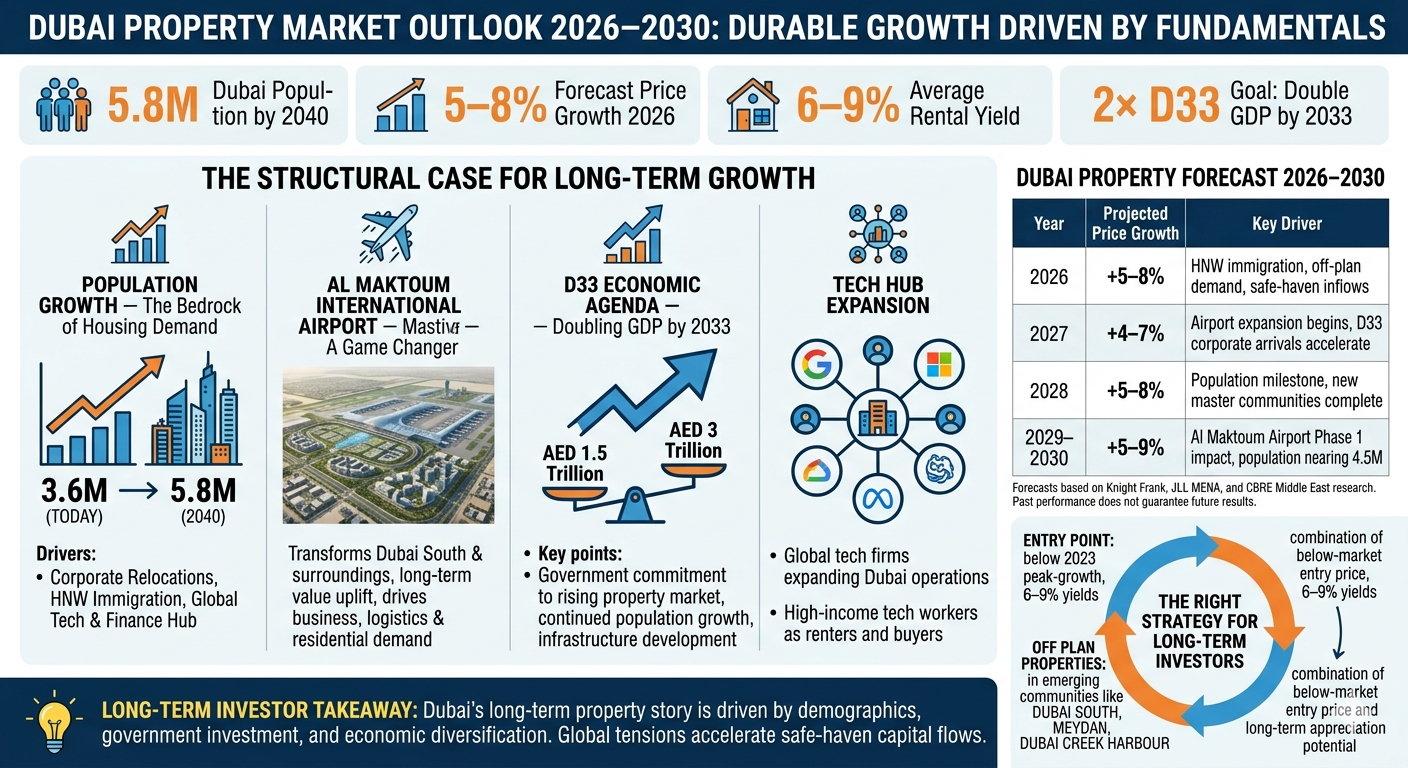
With global uncertainty elevated in 2026, investors are asking: is the Dubai property story durable? The answer, backed by structural data and government planning, is a clear yes.
5.8MDubai Population by 2040
5–8%Forecast Price Growth 2026
6–9%Average Rental Yield
2×D33 Goal: Double GDP by 2033
The Structural Case for Long-Term Growth
Short-term geopolitical noise does not change the long-term fundamentals that drive Dubai property values. Here are the forces that will shape the market through 2030 and beyond:
Population Growth — The Bedrock of Housing Demand
Dubai’s population is set to grow from 3.6 million today to 5.8 million by 2040 under the Dubai 2040 Urban Master Plan. More residents means more demand for housing — and more sustained upward pressure on both property values and rental yields. This demographic trajectory is driven by corporate relocations, HNW immigration, and the city’s growing role as a global tech and finance hub.
Al Maktoum International Airport — A Game Changer
The expansion of Al Maktoum International Airport into what will be the world’s largest airport (when complete) will transform Dubai South and the surrounding communities. Properties in the vicinity — already appreciating — are expected to see significant long-term value uplift as the airport drives business, logistics, and residential demand in southern Dubai.
D33 Economic Agenda — Doubling GDP by 2033
Dubai’s D33 Agenda targets doubling the emirate’s GDP from AED 1.5 trillion to AED 3 trillion by 2033. This requires continued population growth, corporate attraction, and infrastructure development — all of which translate directly into sustained property demand. A government committed to doubling economic output is a government committed to a rising property market.
Tech Hub Expansion
Dubai Internet City, Dubai Silicon Oasis, and DIFC’s FinTech Hive are attracting global tech companies at an accelerating pace. Google, Microsoft, Meta, and dozens of major tech firms have expanded Dubai operations. Tech workers are high-income renters and buyers — and their numbers are growing rapidly.
Dubai Property Forecast 2026–2030
| Year | Projected Price Growth | Key Driver |
|---|---|---|
| 2026 | +5–8% | Continued HNW immigration, off-plan demand, safe-haven inflows |
| 2027 | +4–7% | Airport expansion begins, D33 corporate arrivals accelerate |
| 2028 | +5–8% | Population milestone, new master communities complete |
| 2029–2030 | +5–9% | Al Maktoum Airport Phase 1 impact, population nearing 4.5M |
Forecasts based on Knight Frank, JLL MENA, and CBRE Middle East research. Past performance does not guarantee future results.
💡 Long-Term Investor Takeaway
Dubai’s long-term property story is driven by demographics, government investment, and economic diversification — not oil or regional politics. Global tensions, if anything, accelerate safe-haven capital flows to Dubai and strengthen the long-term case.
The Right Strategy for Long-Term Investors
For investors with a 5–10 year horizon, the current entry point — with prices still below their 2023 peak-growth rate and yields at 6–9% — represents one of the most favourable long-term setups in Dubai’s history. Off plan properties in emerging communities like Dubai South, Meydan, and Dubai Creek Harbour offer the best combination of below-market entry price and long-term appreciation potential.

Join The Discussion