

 by
by 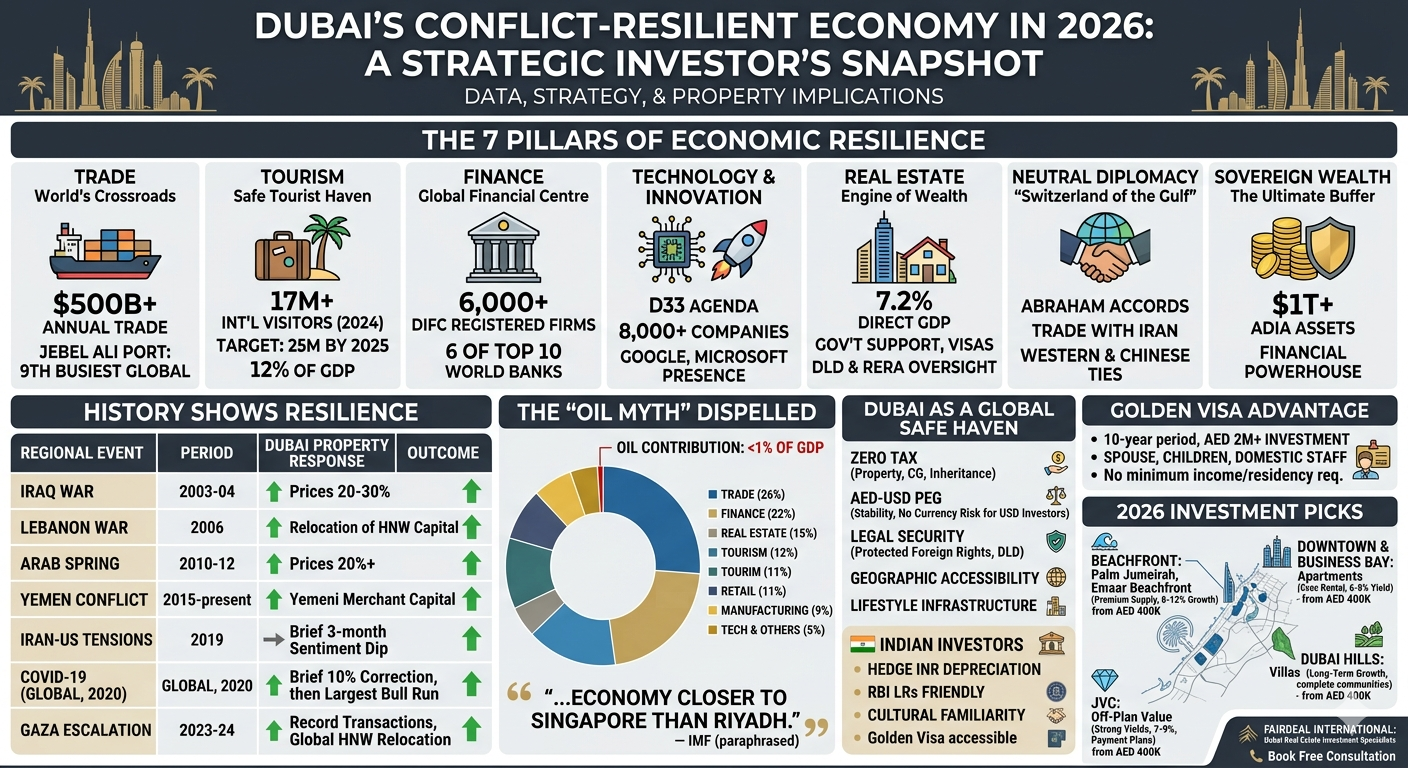
While Middle East headlines create anxiety for investors worldwide, Dubai has quietly built one of the most conflict-resilient economies on the planet. Here’s the data, the strategy, and what it means if you want to buy property in Dubai right now.
Why This Question Matters for Every Property Investor
If you’ve been following the news, you’ve seen the headlines — missile strikes, airspace disruptions, naval tensions, diplomatic crises. The Middle East, as always, is rarely far from global media coverage. And for anyone looking to buy property in Dubai, a natural question emerges: Does regional conflict put my investment at risk?
The short answer, backed by over two decades of data, is: No — and in many cases, the opposite is true.
Dubai has navigated the Gulf War, the 2003 Iraq invasion, the Arab Spring, Yemen conflict, Iran tensions, and multiple Israel-Palestine escalations — and throughout every single one of these events, Dubai’s property prices either held firm or rose. This isn’t luck. It’s architecture. Dubai’s economy is deliberately, systematically built to be conflict-resilient.
In this article, we break down exactly how — and what it means for your decision to invest in Dubai real estate in 2026.
📌 Before you continue
This is the third article in our series on Dubai property investment safety. Read our earlier analyses: Is Dubai Safe for Property Investment in 2026? and What Current Middle East Tensions Mean for Dubai Real Estate Investors for the complete picture. Section 01
The 7 Pillars of Dubai’s Conflict-Proof Economy
Dubai’s economic resilience isn’t accidental. Over the last 30 years, its leadership has constructed an economic architecture specifically designed to thrive regardless of what happens in its region. Here are the seven structural pillars that make Dubai’s economy uniquely resilient:
1. Trade — The World’s Crossroads
Dubai handles over $500 billion in annual trade through Jebel Ali Port, the world’s largest man-made harbour and the 9th busiest port globally. As the geographic midpoint between East and West, Dubai’s trade corridors connect Asia, Africa, and Europe. Regional conflict typically increases demand for Dubai’s logistics and re-export services as alternative routes and neutral ground.
2. Tourism — 20+ Million Visitors a Year
Dubai welcomed over 17 million international visitors in 2024 and is targeting 25 million by 2025. Tourism now contributes approximately 12% of Dubai’s GDP — a revenue stream almost entirely disconnected from regional oil politics. The Expo 2020 legacy infrastructure, luxury hospitality developments, and world-class entertainment make Dubai a destination that conflict in neighbouring countries does not diminish — it enhances, as Dubai becomes the safe tourist haven in the region.
3. Finance — A Global Financial Centre
The Dubai International Financial Centre (DIFC) is home to 6,000+ registered companies and 6 of the 10 world’s top banks. Dubai’s legal system (DIFC has its own English common law courts), regulatory framework, and financial infrastructure have positioned it alongside London, New York, and Singapore as a global money hub. Crisis capital flows to financial stability — and DIFC is a primary beneficiary when regional investors seek safe jurisdictions.
4. Technology & Innovation
Dubai’s D33 Economic Agenda targets doubling the emirate’s GDP by 2033, with technology at its core. Dubai Internet City, Dubai Silicon Oasis, and Dubai Media City host 8,000+ companies. Global tech giants including Google, Microsoft, Meta, and Amazon Web Services have significant Dubai presences. A tech-driven economy is naturally more resilient to regional physical conflicts than an industrial or oil-dependent one.
5. Real Estate — The Engine of Wealth Creation
Real estate contributes approximately 7.2% of Dubai’s GDP directly and far more indirectly through construction, finance, and services. The government actively supports the property market through regulation, investor visa incentives, and developer oversight — meaning a property market collapse would be a policy failure Dubai’s leadership works hard to prevent.
6. Neutral Diplomacy — The “Switzerland of the Gulf”
The UAE maintains formal diplomatic relations with Israel (Abraham Accords), functional trade ties with Iran, strong Western military partnerships, and growing Chinese economic relationships simultaneously. This deliberate diplomatic neutrality is a strategic economic asset. No regional player wants Dubai destabilised — it serves everyone as a neutral meeting point and trade facilitator.
7. Sovereign Wealth — The Ultimate Buffer
Abu Dhabi’s ADIA (Abu Dhabi Investment Authority) manages an estimated $1 trillion in assets — one of the world’s largest sovereign wealth funds. Even in a severe economic scenario, the UAE has the financial firepower to stabilize its economy for decades. Investors who understand this rarely lose sleep over regional tensions.
$500B+Annual Trade Through Dubai
17M+Annual Tourists (2024)
$1TADIA Sovereign Wealth
6,000+DIFC Registered FirmsSection 02
What History Shows: Past Regional Conflicts vs Dubai Property Prices
The most powerful evidence for Dubai’s resilience isn’t theory — it’s the empirical track record across multiple crises over 25+ years.
| Regional Event | Period | Dubai Property Response | Outcome |
|---|---|---|---|
| Iraq War (US Invasion) | 2003–2004 | Prices rose 20–30%. Capital flooded from Iraq into Dubai safe haven. | ↑ Positive |
| Lebanon War | 2006 | Lebanese HNW capital relocated to Dubai en masse. Property demand surged. | ↑ Positive |
| Arab Spring | 2010–2012 | Dubai property prices rose 20%+ as Arab world’s stable alternative. Population inflow from Egypt, Libya, Syria. | ↑ Strongly Positive |
| Yemen Conflict | 2015–present | Minimal direct impact. Yemeni merchant capital accelerated relocation to Dubai. | ↑ Neutral/Positive |
| Iran-US Tensions (Strait of Hormuz) | 2019 | Brief sentiment dip (3 months), followed by recovery. AED-USD peg held. | → Neutral |
| COVID-19 (Global, not regional) | 2020 | Brief 10% correction Q2 2020, followed by the largest bull run in Dubai history (2021–2023). | ↑ Recovery + Boom |
| Gaza Conflict Escalation | 2023–2024 | Record transaction volumes in 2024. Global HNW capital relocated to Dubai. Prices up 20%+ in prime areas. | ↑ Strongly Positive |
💡 The Pattern is Clear
In every regional conflict of the last 25 years, Dubai’s real estate market has either been unaffected or directly benefited — as capital, families, and businesses flee instability and arrive in Dubai. The only significant correction was COVID-19 (a global event), which recovered within 18 months into the strongest bull run the market had ever seen.Section 03
The “Oil Myth”: Why Dubai’s Economy Isn’t What You Think
Many first-time investors from India and Europe carry a mental model of Dubai as an “oil economy” that will collapse when oil runs out or prices fall. This picture is decades out of date.
Oil’s contribution to Dubai’s GDP is now less than 1%. Yes — under one percent. Dubai ran out of significant oil reserves in the 1980s, and this actually became its greatest advantage. Forced to diversify early, Dubai built a modern, post-oil economy long before its Gulf neighbours needed to. Today, Dubai’s economy is driven by:
- Trade & Logistics: ~26% of GDP
- Finance & Business Services: ~22% of GDP
- Real Estate & Construction: ~15% of GDP
- Tourism & Hospitality: ~12% of GDP
- Retail & Consumer Services: ~11% of GDP
- Manufacturing: ~9% of GDP
- Other (Tech, Education, Health): ~5% of GDP
This means that a sustained drop in oil prices — a risk that actually affects Abu Dhabi, Saudi Arabia, and Kuwait significantly — has minimal direct impact on Dubai. Investors who fear Dubai because of oil price volatility are fighting the last war.
Dubai’s economic model is closer to Singapore than Riyadh. It is a services hub, a logistics node, and a global financial centre — and it operates almost independently of the regional resource economy around it.— Economic framework analysis, IMF Article IV Consultation: UAE, 2025Section 04
Dubai as a Global Safe Haven — Where Money Flows During Crises
One of the most important concepts for property investors to understand is that Dubai is not just unaffected by crises — it actively attracts capital during them. This “safe haven” dynamic is structural, not coincidental.
Why Capital Flows to Dubai During Conflict
- Zero property tax, zero capital gains tax, zero inheritance tax — wealth preservation is maximized in Dubai versus any Western alternative
- AED-USD peg — the UAE Dirham has been pegged to the US Dollar since 1997 at a fixed rate of 3.67 AED/USD. This eliminates currency risk for USD-holding investors and provides exceptional stability
- Legal security — RERA (Real Estate Regulatory Authority) and DLD provide a well-regulated framework. Foreign property ownership rights are clearly protected in law
- Geographic accessibility — Dubai is within 4 hours of 2/3 of the world’s population. It is the practical refuge for capital from South Asia, East Africa, the Levant, and Central Asia
- Lifestyle infrastructure — world-class healthcare, international schools, and luxury amenities make it a practical destination for wealthy families relocating from conflict-affected countries
📊 The 2023–2024 Data Point
When the Gaza conflict escalated in October 2023, Dubai’s DLD reported a 36% increase in international property inquiries in the following 90 days. Russian, Israeli, and Lebanese buyers accelerated their Dubai purchases. The Dubai property market recorded its highest-ever transaction year in 2024.
The AED-USD Peg: Why It Matters for Your Investment
For Indian investors buying property in Dubai, the stability of the AED against the USD means your investment doesn’t suffer from the currency volatility that affects investments in countries with floating currencies. While the INR has depreciated approximately 3–4% annually against the USD historically, your Dubai property value in USD terms remains stable, and any capital appreciation adds directly to your real returns.Section 05
Direct Impact on Dubai Property Investment in 2026
So what does all of this mean practically for someone considering buying property in Dubai or investing in off plan apartments Dubai right now?
📌 Key Takeaways for Property Investors in 2026
- 🏗️Off plan property Dubai — Pipeline remains strong. Developers including Emaar, Damac, Nakheel, and Sobha continue to launch new projects with developer payment plans of 60/40 or 70/30. These lock in today’s prices with delayed payment, making now an ideal entry for off plan apartments Dubai buyers.
- 💰Dubai rental yield remains exceptional at 6–9% gross for apartments in mid-market areas like JVC, Dubai South, Business Bay, and Dubai Marina — far exceeding London, Mumbai, or Sydney equivalents.
- 📈Dubai property price trends show continued mid-market appreciation of 6–8% forecast for 2026. Waiting costs investors both entry price and rental income.
- 🌊Beachfront property Dubai and waterfront villas Dubai continue to outperform, with premium supply limited by geography. Emaar Beachfront, Palm Jumeirah, and Dubai Creek Harbour waterfront units show 10–15% price premiums and 3–6 month waitlists for the best units.
- 🏢Luxury apartments Dubai and luxury villas Dubai in prime locations show resilience to any regional uncertainty as HNW buyers see Dubai as a stable primary or secondary residence.
For a complete breakdown of the best areas to invest in Dubai property, including ROI data for each community, visit our detailed location guide.Section 06
Especially for Indian Investors: Why This is Your Moment to Buy Property in Dubai from India
Indians represent the largest foreign buyer group in Dubai’s property market year after year — and for very good reason. If you’re considering how to buy property in Dubai from India, the current environment is arguably the most favourable it has ever been.
Why Indian Buyers Dominate Dubai Real Estate
- Cultural familiarity: 3.5 million Indians live in the UAE — the largest expat community in the country. Indian food, language, culture, and community infrastructure are world-class in Dubai.
- RBI Liberalized Remittance Scheme (LRS): Indian residents can remit up to USD 250,000 per year for overseas property purchases under LRS. Many Indians combine family members’ LRS limits for larger purchases.
- INR depreciation hedge: As the Indian Rupee historically depreciates 3–4% annually against the USD, holding a Dubai property effectively hedges this currency erosion for Indian investors.
- NRI-friendly process: The Dubai property purchase process is fully accessible to NRIs and Indian residents alike, with digital KYC, power of attorney options, and Indian bank international wire transfers.
- Price comparison: Cheap property in Dubai for investment starts from AED 400,000 (approximately ₹95 lakhs) for studios in emerging areas — comparable to mid-range Mumbai suburbs but with far higher rental yields and zero property tax.
🇮🇳 Indian Investor Quick Facts
Indians accounted for approximately 22% of all Dubai property transactions in 2024, investing over AED 60 billion. The top buyer nationalities were India, UK, China, Russia, and Italy — with India leading for the fourth consecutive year.
For a step-by-step process on how to buy property in Dubai from India, including LRS documentation, escrow requirements, and DLD registration, speak to our specialist team at Fairdeal International who handle India-to-Dubai purchases regularly.Section 07
The Dubai Property Golden Visa: Long-Term Security Beyond the Investment
Perhaps the most underappreciated benefit of buying property in Dubai during times of regional uncertainty is the UAE Golden Visa — a 10-year renewable residency visa tied to your property investment.
Dubai Property Golden Visa — Key Facts
| Criteria | Details |
|---|---|
| Minimum Property Value | AED 2,000,000 (approx. USD 545,000 / ₹4.6 Crore) |
| Visa Duration | 10 years, renewable indefinitely |
| Family Coverage | Spouse + children (all ages) + domestic staff |
| Income Requirement | No minimum income requirement for property investors |
| Residence Requirement | No mandatory days-in-UAE requirement |
| Property Type | Completed property (not off-plan) in designated freehold areas |
| Mortgage Eligibility | Mortgaged property qualifies if equity value ≥ AED 2M |
For Indian investors specifically, the Dubai property investor visa (Golden Visa) provides an extraordinary benefit: a UAE residency that protects your right to buy property in Dubai for residency purposes — essentially a second home country — without requiring you to give up your Indian citizenship or residency.
This is a unique value that no European, US, or Asian property market provides at this price point. A USD 545,000 investment gives your entire family a 10-year renewable legal right to live in one of the world’s most stable, prosperous cities — regardless of what happens in any neighbouring country.
Interested in the Dubai Golden Visa Through Property?
Our team at Fairdeal International specialises in helping Indian and international investors secure their Golden Visa through strategic property purchases. Free consultation available.Book Free Consultation → View AED 2M+ PropertiesSection 08
Best Areas to Buy Property in Dubai in 2026: Conflict-Resilient Picks
Not all Dubai areas offer equal resilience or returns. Here are the top picks for investors in 2026, balancing growth potential, rental yield, and capital safety:
🏖️ Beachfront & Waterfront — Premium Resilience
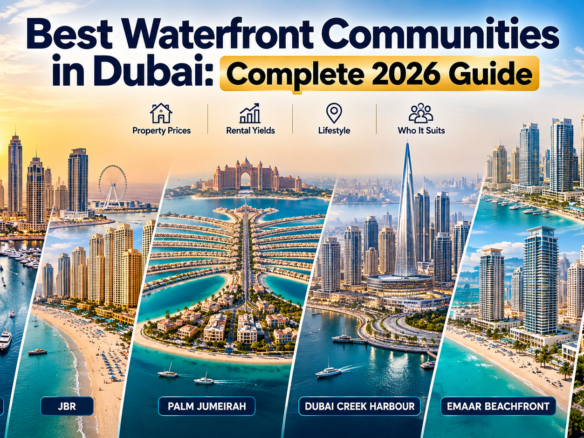
Beachfront property Dubai and waterfront villas Dubai in areas like Emaar Beachfront, Palm Jumeirah, Dubai Creek Harbour, and Bluewaters Island hold value exceptionally well during any market uncertainty. Limited supply by geographic constraint means prices are defended from below. Rental yields of 5–7% with capital appreciation of 8–12% are achievable.
🏙️ Downtown Dubai & Business Bay — Apartments for Sale
Downtown Dubai apartments for sale and Business Bay apartments for sale cater to the executive rental market — a demographic that is demand-resilient even during economic volatility. Average yields of 6–8% with strong resale liquidity.
🌊 Dubai Marina — Lifestyle + Yield
Apartments for sale Dubai Marina remain perennially popular with expat tenants and short-term rental investors. Dubai Marina’s established infrastructure, walk-to-beach lifestyle, and brand recognition make it one of the most liquid sub-markets in the city.
🌿 Dubai Hills Estate — Villas for Long-Term Growth
Dubai Hills villas for sale appeal to families seeking community living, green space, and long-term capital growth. With the Dubai Hills Mall, international schools, and golf course, this is one of Dubai’s most complete master-planned communities — and values have appreciated 60%+ since 2020.
💎 JVC — Off Plan for Value Entry
JVC apartments for sale are the entry point for investors seeking strong rental yields (7–9%) at accessible price points. Off plan apartments Dubai in JVC from quality developers offer AED 600K–900K units with developer payment plans — ideal for first-time Dubai investors.
Browse all current projects: View Off Plan Properties in Dubai →Section 09
Final Word: Is Regional Conflict a Reason to Avoid Dubai — or to Accelerate?
After examining the economics, the history, and the data, the answer for most investors is clear: regional conflict is not a reason to avoid Dubai property investment — it is historically been a catalyst for it.
Dubai’s seven economic pillars, its role as the Gulf’s neutral diplomatic hub, its AED-USD peg stability, its sovereign wealth backstop, and its two-decade track record of absorbing regional shocks without property market correction — all point in the same direction.
Combine this with the specific attractions of 2026: off plan apartments Dubai with developer payment plans locking in today’s prices, rental yields of 6–9% outperforming global alternatives, the Dubai property Golden Visa providing 10-year family residency at AED 2M, and a Dubai property forecast 2026 of continued 5–8% growth — and the case for action rather than delay becomes compelling.
✅ The Fairdeal View
For investors from India and globally looking to buy property in Dubai in 2026: the risk of waiting outweighs the risk of buying. Choose your area carefully, choose established or reputable developers, and maintain a 3–5 year minimum horizon. The fundamentals will do the work.
Ready to take the next step? Our team at Fairdeal International specialises in helping investors from India and worldwide navigate the Dubai market — from identifying the right off plan property Dubai or ready property to managing the end-to-end purchase process, Golden Visa, and property management.
Ready to Buy Property in Dubai? Let’s Talk.
Fairdeal International’s experts specialise in helping Indian and international investors find the right Dubai property. Free consultation — no obligation.📞 Book Free Consultation 🏗️ Browse Off Plan Projects
Fairdeal International
Dubai Real Estate Investment Specialists
Fairdeal International is a Dubai-based property consultancy specialising in off-plan and ready properties for Indian and international investors. With expertise across Dubai Marina, Palm Jumeirah, JVC, Dubai Hills, and emerging communities, our team guides investors from first enquiry through to Golden Visa processing.
📚 Continue Reading: Dubai Investment Series
📌 Blog 1 in Series Is Dubai Safe for Property Investment in 2026? Latest Dubai Real Estate Market Trends
📌 Blog 2 in Series What Current Middle East Tensions Mean for Dubai Real Estate Investors
📌 Blog 3 in Series Should You Delay Buying Property in Dubai Right Now?

Join The Discussion