

 by
by 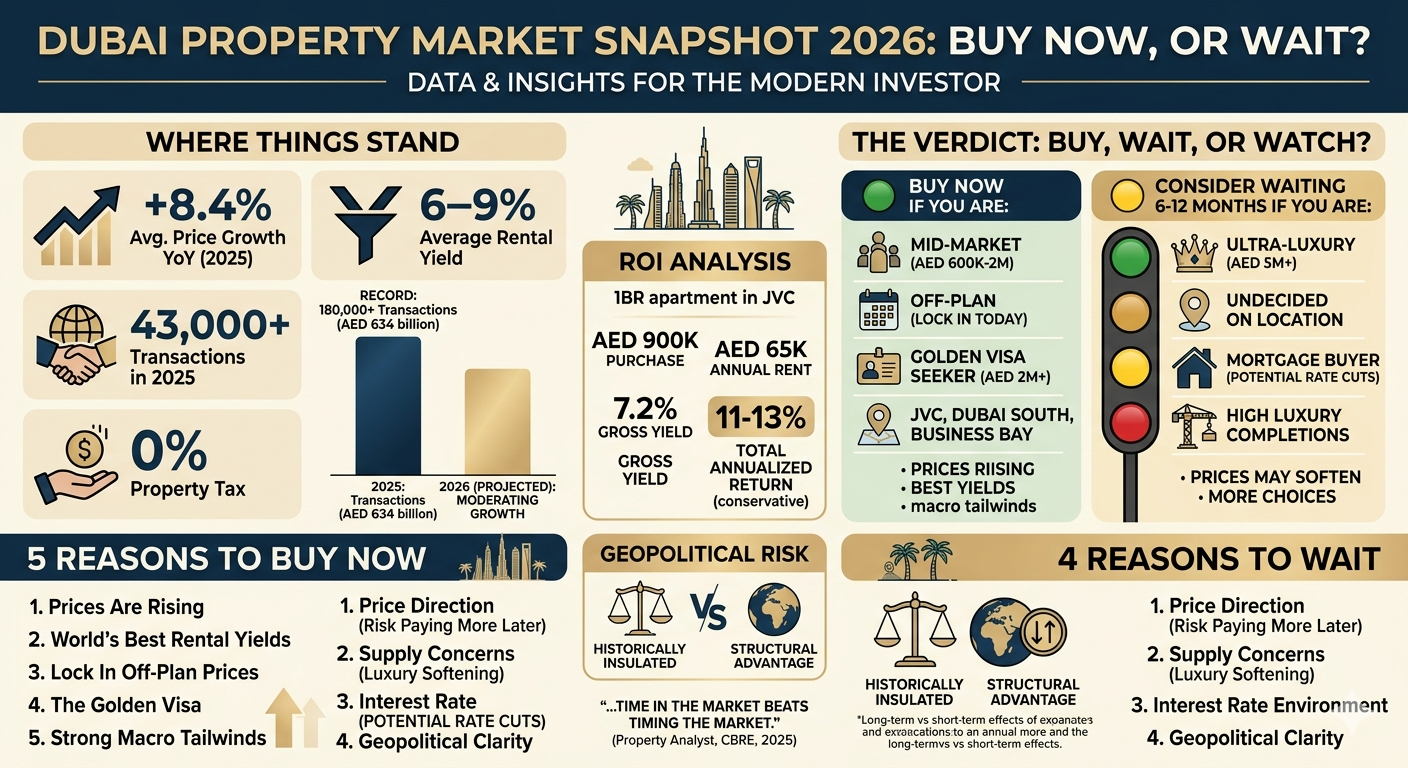
The question every investor is asking in 2026: with prices rising, regional uncertainty simmering, and a flood of new supply hitting the market is now still the right time to buy, or should you wait for a dip that may never come?
Dubai Property Market Snapshot: Where Things Stand in 2026
Before answering whether you should delay your purchase, it’s critical to understand exactly where the Dubai real estate market stands today. The market has evolved considerably since the post-pandemic boom years of 2021–2023, and 2026 presents a more nuanced landscape for investors.
+8.4%Avg. Price Growth YoY (2025)
6–9%Average Rental Yield
43,000+Transactions in 2025
0%Property Tax
According to data published by the Dubai Land Department (DLD), the emirate recorded over 180,000 real estate transactions worth AED 634 billion in 2025 — a record year. The trajectory into 2026 shows moderation in growth rate but no signs of reversal.
Key areas like Dubai Marina, Downtown Dubai, JVC, and Palm Jumeirah continue to show above-average demand, while emerging communities like Dubai South, Dubai Creek Harbour, and Meydan are attracting investors seeking value-growth plays. If you haven’t read our analysis of regional risks, start with our earlier piece: Is Dubai Safe for Property Investment in 2026?
💡 Key Context The question isn’t whether Dubai property is a good investment — the fundamentals are clear. The real question is whether your specific circumstances make this the right entry point for you personally.
5 Compelling Reasons to Buy Dubai Property Now, Not Later
1. Prices Are Rising — Waiting Costs You Money
The most important consideration: Dubai property prices have risen consistently since 2020 with only brief pauses. Analysts at JLL MENA and Knight Frank forecast continued growth of 5–8% for mid-market properties in 2026. Waiting for a price correction that fails to materialize means paying more — and losing rental income in the interim.
2. Rental Yields Remain Among the World’s Best
With rental yields of 6–9% gross in areas like JVC, Dubai South, and Business Bay, Dubai significantly outperforms London (3–4%), New York (3–5%), and Sydney (3–4%). Investors purchasing today can generate strong cash flow from day one. This is particularly relevant for buy-to-let investors seeking income rather than pure capital appreciation.
3. Off-Plan Payment Plans Lock In Today’s Prices
One of Dubai’s unique advantages is the developer-facilitated payment plan structure. Many developers offer 60/40 or 70/30 splits — meaning you pay a fraction now and the balance on completion (18–36 months away). This effectively lets you lock in 2026 prices while paying over 2027–2028, often with 0% finance charges. See our guide: Best Off-Plan Property Developers in Dubai 2026.
4. The Golden Visa — A Powerful New Incentive
A property purchase of AED 2 million or above qualifies buyers for the UAE Golden Visa — a 10-year renewable residency that covers the entire family. This transforms Dubai real estate from a pure investment into a lifestyle and residency strategy, a unique value that no other major market provides at this price point.
5. Strong Macro Tailwinds Show No Signs of Stopping
Dubai’s population is projected to grow from 3.6 million to 5.8 million by 2040 under the Dubai 2040 Urban Master Plan. With population growth comes housing demand. The city is also seeing increased corporate relocations, a growing tech hub, and a post-pandemic pivot of wealthy individuals from Western cities — all sustaining demand fundamentals.Section 03
4 Genuine Reasons You Might Want to Wait
We believe in balanced analysis. Here are the real arguments for patience:
| Factor | Buy Now | Wait 6–12 Months |
|---|---|---|
| Price Direction | ✓ Lock in current prices before further rises | ✗ Risk paying 5–8% more next year |
| Supply Concerns | ~ Mid-market supply healthy; luxury may soften | ✓ Large luxury completions may create brief buying opportunity |
| Interest Rate Environment | ~ AED pegged to USD; rates moderating | ✓ Potential further rate cuts improve mortgage terms |
| Geopolitical Clarity | ✗ Regional tensions remain elevated | ✓ Wait for clearer geopolitical resolution |
| Developer Selection | ~ Good choice now; competition fierce | ✓ More new launches to compare in H2 2026 |
| Rental Income | ✓ Start earning 6–9% yield immediately | ✗ Every month delayed = lost rental income |
Supply in luxury segments is one genuine concern. A significant pipeline of ultra-luxury completions (AED 5M+) is expected through 2026–2027. If your target is the luxury segment, a brief window of relative softness is possible. However, this dynamic does not apply to mid-market properties (AED 600K–AED 2M), where demand continues to outpace supply.
For a deep dive into regional risk factors impacting this decision, read our related analysis: What Current Middle East Tensions Mean for Dubai Real Estate Investors.
The investors who consistently outperform in Dubai are not those who time the market perfectly — they’re those who hold the highest quality assets in the best locations for the longest periods. In this market, time in the market beats timing the market.— Property Analyst, CBRE Middle East (paraphrased from CBRE MENA Research, 2025)Section 04
Dubai Property Price Forecast: What Analysts Predict for 2026–2028
Multiple international research houses have published Dubai residential property forecasts. The consensus picture for 2026:
- Knight Frank: Projects 5% growth for prime residential in 2026, moderated from the 15–20% peaks of 2022
- JLL MENA: Forecasts 6–8% average residential price growth across mid-market; cautions on luxury oversupply in select micro-markets
- Savills Middle East: Identifies Dubai as one of the top 5 global cities for price growth momentum through 2027
- CBRE Middle East: Notes strong rental demand supporting capital values; structural undersupply in 1BR/2BR apartments
⚠️ What Could Cause Prices to Fall?A significant oil price shock (below $50/bbl sustained), a major regional conflict escalation directly affecting UAE, a sudden reversal of global wealth migration trends, or a dramatic oversupply shock would be required to tip Dubai into negative territory — none of which are base-case scenarios for 2026.
Looking at 2027–2028, the Dubai Expo 2020 legacy infrastructure, the expansion of Al Maktoum International Airport into what could be the world’s largest, and the continued rollout of Dubai’s digital economy strategy all point to sustained population and economic growth that underpins property demand.Section 05
ROI Analysis: What Does Your Dubai Property Investment Actually Earn?
Let’s move from theory to numbers. Here is a realistic return analysis for a mid-market Dubai apartment purchase in 2026:
AED 900KAvg. 1BR in JVC / Dubai South
AED 65KAvg. Annual Rent (1BR)
7.2%Gross Rental Yield
5.8%Net Yield (after costs)
Adding capital appreciation of ~6% per year (conservative estimate), a total annualised return of 11–13% is achievable — before leverage. With a 30–40% mortgage, equity returns can exceed 20% annually for well-chosen properties. Compare this to global fixed income (4–5%) or Western residential property (5–8% total return) and the Dubai value proposition becomes clear.
For a detailed breakdown of costs including DLD registration fees, agent commissions, service charges, and maintenance, visit our complete guide: Full Cost Breakdown for Buying Property in Dubai (2026).Section 06
Does Geopolitical Risk in the Middle East Change Your Decision?
This is the nuanced question most property websites avoid addressing directly. The answer is: it depends on the nature and proximity of the risk, and Dubai has a structural advantage most investors underestimate.
Why Dubai Has Historically Been Insulated
The UAE has maintained its status as a neutral diplomatic player throughout successive regional conflicts. Its leadership in normalizing relations with Israel (Abraham Accords, 2020), maintaining functional relationships with Iran while building Western alliances, and positioning Dubai as a global financial safe haven has historically meant that regional conflicts boost Dubai’s property market rather than damaging it — as capital from conflict zones flows into Dubai.
The Risks That Are Real
That said, sustained conflict that impacts global oil prices, disrupts Gulf shipping lanes, or triggers a broader GCC economic contraction would have macro impacts on Dubai real estate. We analyzed this in depth in our post: What Current Middle East Tensions Mean for Dubai Real Estate Investors. Short answer: elevated regional tension has historically been a buying signal for Dubai property, not a warning to exit.
The IMF’s World Economic Outlook continues to project UAE GDP growth of 4.5% for 2026–2027, above the global average, reinforcing Dubai’s economic fundamentals independent of regional tensions.Section 07
Which Investor Profile Should Buy Now vs. Wait?
Not all investor decisions are identical. Here’s our framework:
🟢 Buy Now If You Are:
- A mid-market buyer targeting AED 600K–2M apartments in established communities
- An off-plan investor with a 3–5 year horizon who wants to lock in today’s price
- A buyer seeking rental income from a cash-flow positive property
- Eligible and interested in the UAE Golden Visa (AED 2M+ threshold)
- A cash buyer or mortgage buyer in a market where rates are plateauing/declining
- A global HNW individual diversifying from Western real estate or equity markets
🟡 Consider Waiting 6–12 Months If You Are:
- Targeting ultra-luxury (AED 5M+) in Palm Jumeirah or Downtown — where supply completions may create temporary softness
- Undecided on location and want to see more H2 2026 launches for comparison
- Waiting for potential further interest rate improvements on a large mortgage
- In the process of liquidating existing assets to fund a Dubai purchase
🔴 Do Not Buy If You Are:
- Expecting a short 12-month flip with guaranteed capital gains — that era has largely passed
- Highly leveraged with limited ability to service mortgage if rents temporarily soften
- Purchasing from a developer with weak track record or financial standing (conduct due diligence via RERA)
Section 08
Off-Plan vs Ready Property: Does the Timing Logic Differ?
The “buy now vs wait” calculus is fundamentally different for off-plan and ready properties, and most generic advice conflates the two.
For Off-Plan Property
Waiting rarely makes sense. Off-plan prices are typically lower at launch and rise as construction progresses. Developers sell at a discount to market value at launch to generate sales velocity — this discount erodes as the project approaches completion. Waiting 12 months often means paying 10–20% more for the same unit. The PropertyFinder Market Report consistently shows off-plan launch prices outperforming resale in the medium term for quality projects.
For Ready/Secondary Market Property
More timing flexibility exists here. Ready properties in the luxury segment may see brief price softness in late 2026 as a wave of completions hits the market. Mid-market ready properties, however, continue to see strong competition from end-users and investors alike, with limited inventory in popular communities creating a seller’s market. Waiting for a meaningful correction in mid-market ready stock may mean waiting indefinitely.
Final Verdict: Buy, Wait, or Watch in 2026?
After analyzing the data, the market conditions, geopolitical context, and investor psychology — here is our considered position:
📌 Our VerdictFor most mid-market investors and buyers targeting the AED 600K–AED 3M range —buying now is better than waiting. Prices are unlikely to offer a meaningful correction opportunity, and every month of delay represents lost rental income and a higher entry price. The only valid reasons to delay are luxury-segment targeting, ongoing financial restructuring, or specific geopolitical risk thresholds that you’ve set as personal red lines.
The fundamental mistake investors make in Dubai is assuming the market will “come back to them.” Dubai’s property market is in a structural growth phase backed by population growth, government infrastructure investment, favorable tax policy, and global wealth migration. This structural tailwind doesn’t disappear in 6 months.
That said — what you buy matters more than when you buy. A wrong asset (poor location, weak developer, overpriced) held for 5 years will underperform a right asset bought at any reasonable point in the cycle. Due diligence on the property itself is more important than perfect market timing.
Ready to take the next step? Read our comprehensive entry on Is Dubai Safe for Property Investment in 2026? — and then our analysis on What Current Middle East Tensions Mean for Dubai Real Estate Investors to complete your picture.

Join The Discussion